

Change has become one of the most overused words in business.
Digital transformation. Organisational restructuring. New strategies. New systems. New leaders.
Yet despite all this movement, many organisations feel… stuck.
Why?
Because change is often treated as an event, when in reality it is a human process.
At ReNu, we believe that sustainable change does not start with policies, structures, or frameworks.
It starts with people — how they think, feel, behave, and make meaning of what’s happening around them.
The real reason change fails
Most change initiatives fail not because the strategy was wrong, but because the human system was ignored.
Common symptoms we see:
Resistance labelled as “attitude problems”
Leaders pushing harder instead of listening deeper
Burnout disguised as “change fatigue”
Compliance without commitment
Neuroscience and behavioural science tell us this clearly:
The brain is wired for safety, predictability, and belonging.
When change threatens any of these, people don’t lean in — they protect themselves.
That protection can look like:
Disengagement
Withdrawal
Conflict
Passive compliance
Or quiet quitting
None of which lead to meaningful transformation.
The ReNu perspective on change
At ReNu, we approach change through a renewal lens, not a disruption lens.
Change is not about breaking what exists —
it’s about renewing what no longer serves and strengthening what does.
Our work is guided by three core beliefs:
1. Insight precedes impact
You cannot change what you do not understand.
This is why we start with:
Psychometric insight
Behavioural patterns
Culture diagnostics
Leadership styles and decision-making tendencies
When people gain insight into why they think and behave the way they do, defensiveness drops and ownership increases.
Clarity creates choice.
Choice creates change.
2. Change lives in the middle — not the strategy deck
The success of any change initiative is decided in everyday moments:
Conversations between line managers and team members
How performance feedback is handled
How uncertainty is communicated
How mistakes are treated
Line managers are not the “middle layer” of change —
they are the multiplier.
Without equipping leaders with the skills, language, and confidence to lead change in real time, even the best strategies will stall.
3. Sustainable change balances performance and wellbeing
Pressure without support leads to burnout.
Support without accountability leads to stagnation.
Real change sits at the intersection of:
Clear expectations
Psychological safety
Energy management
Capability building
Wellbeing is not a soft add-on to change.
It is the infrastructure that makes performance possible.
4. From resistance to readiness
One of the most powerful shifts organisations can make is to stop asking:
“Why are people resisting change?”
And start asking:
“What is this resistance trying to protect?”
When leaders approach change with curiosity instead of control, something shifts:
Conversations deepen
Trust increases
People feel seen rather than managed
And with trust comes momentum.
5. Change that lasts is built, not forced
At ReNu, we don’t believe in quick fixes or one-off interventions.
We help organisations:
Diagnose before they design
Design with people, not for them
Deliver practical, embedded solutions
Discipline change through measurement, feedback, and reinforcement
Because change that is not reinforced will always regress.
The ReNu Perspective to Change
At ReNu, we frame change as a renewal journey, not a disruption exercise.
Our change model reflects how people actually experience change — cognitively, emotionally, and behaviourally.
Change becomes sustainable when it follows the way humans naturally adapt — not when it’s forced through timelines and compliance.
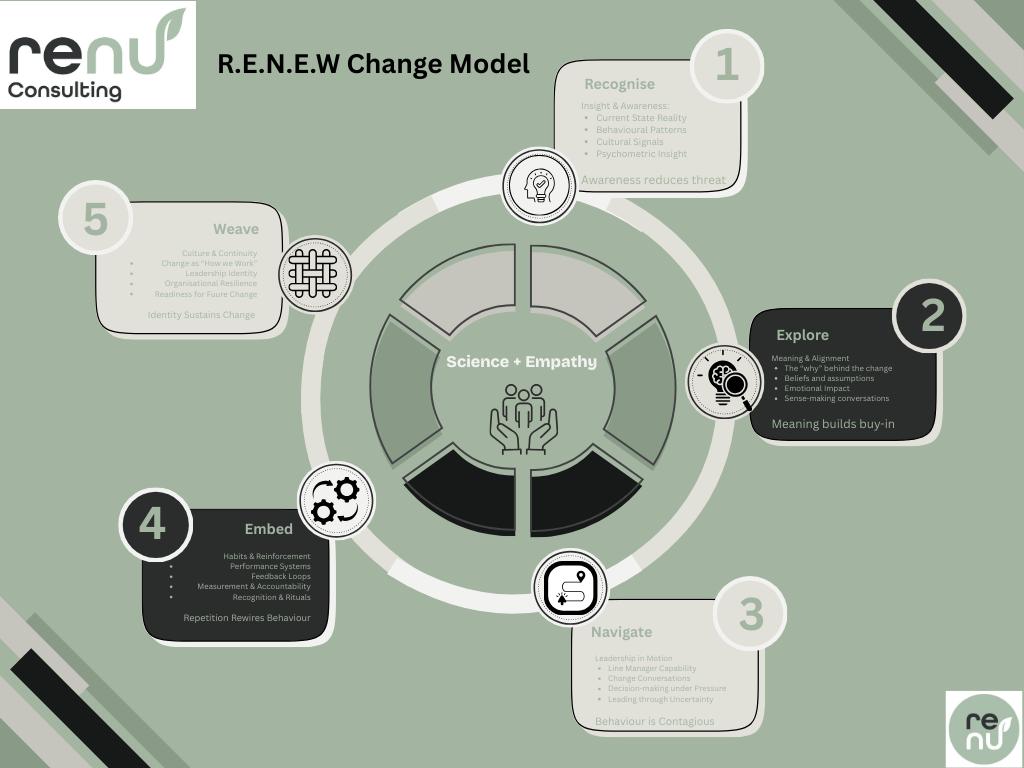
At ReNu, we guide organisations through five phases of renewal:
Recognise → Explore → Navigate → Embed → Weave (R.E.N.E.W)
This model ensures that change is:
Insight-led
Leader-enabled
Behaviour-based
Measured and reinforced
Human and sustainable
Rather than pushing transformation, R.E.N.E.W. helps organisations grow into change.
Let’s look at a step-by-step breakdown.
R – Recognise
Understand what is really happening
Before change can occur, reality must be acknowledged.
This phase focuses on:
Understanding the current state
Naming unspoken fears, fatigue, and resistance
Identifying behavioural patterns, not just process gaps
Using data, psychometrics, and diagnostics to create clarity
Psychological principle: Awareness reduces threat and increases perceived control.
You cannot renew what you refuse to see.
E – Explore
Make meaning before making moves
People don’t resist change — they resist loss of meaning.
This phase focuses on:
Helping individuals and teams understand why change is needed
Connecting organisational goals to personal impact
Exploring beliefs, assumptions, and mindsets
Creating space for questions, uncertainty, and dialogue
Psychological principle: Meaning-making reduces resistance and builds buy-in.
When people understand the “why”, energy replaces fear.
N — Navigate
Equip leaders to lead change in real time
This is where many change efforts fail — the middle.
This phase focuses on:
Equipping line managers with language, tools, and confidence
Building change conversations into daily leadership moments
Coaching leaders to manage emotion, not just execution
Turning strategy into lived behaviour
Psychological principle: People follow behaviour they experience, not messages they hear. Change is won or lost in everyday conversations
E — Embed
Turn new behaviour into new habits
Change that is not embedded will always fade.
This phase focuses on:
Reinforcing desired behaviours through systems and rituals
Aligning performance, feedback, and recognition
Measuring what matters (not just what’s easy)
Creating accountability without fear
Psychological principle: Repetition + reinforcement builds new neural pathways.
What gets reinforced gets repeated.
W — Weave
Make change part of how the organisation operates
The final phase ensures change is not a “project” but a way of being.
This phase focuses on:
Integrating change into culture, leadership identity, and decision-making
Building organisational resilience and adaptability
Ensuring wellbeing and performance evolve together
Preparing the system for the next wave of change
Psychological principle: Identity-based change sustains long-term behaviour.
True change is woven into the fabric of the organisation.
A final thought
Change is not about becoming something completely new.
It’s about renewing alignment —
between strategy and behaviour,
between leaders and teams,
between performance and humanity.
When organisations change with their people instead of to their people,
change stops being something to survive…and becomes something to grow through.